If you've ever browsed a luxury retail website and suddenly thought, "Wow, $38 actually seems reasonable"—even though you originally planned to spend $20—you've likely experienced one of the most powerful sales psychology strategies used by high-volume sellers: Anchored Pricing.
The biggest Etsy and Shopify brands don't simply rely on beautiful products and good photography. They understand buyer psychology. And one of the simplest ways to increase average order value and conversion rates is strategically influencing how customers perceive value.
Let's break down how power sellers use anchored pricing—and how you can implement it in your own store.
What Is Anchored Pricing?
Anchored pricing happens when a shopper sees one price first and uses it as a mental reference point.
That first number becomes the "anchor."
Everything after that is compared against it.
Example:
Imagine entering a coffee shop:
- Small Latte: $5
- Medium Latte: $7
- Large Specialty Latte: $11
Suddenly the $7 option feels like a great middle-ground decision.
Without the $11 option? The $7 drink may have felt expensive.
The higher-priced item changes perception.
Large brands use this strategy constantly because humans don't evaluate prices in isolation—we compare.
Why This Works for Etsy + Shopify Merchants
Most online sellers unknowingly create a pricing problem.
They offer:
- One candle
- One blanket
- One sweatshirt
- One mug
...at one price.
But high-volume sellers create choice architecture.
Instead of asking:
"Do you want to buy this?"
They ask:
"Which option feels best?"
That shift changes everything.
Customers naturally gravitate toward perceived value.
Strategy #1: Use Price Anchors Inside Product Variations
Many high-volume Etsy and Shopify sellers don't create entirely new premium products.
Instead, they strategically structure variations customers already expect.
For example, with personalized candles you may see:
Fragrance-Free Candle — $12.95
Scented Candle — $16.95
Large Candle Size — $24.95
Or even:
Regular Price: $34.95
Sale Price: $17.48 (50% Off Today)
The higher reference price becomes the anchor.
Even if $17.48 was always the intended selling price, customers compare against the original $34.95 price and immediately feel like they're receiving value.
The same thing happens with lower-priced entry options.
A fragrance-free version or smaller size captures shoppers with a lower starting point, while upgraded versions naturally increase average order value.
You didn't necessarily lower pricing.
You changed how customers perceive value.
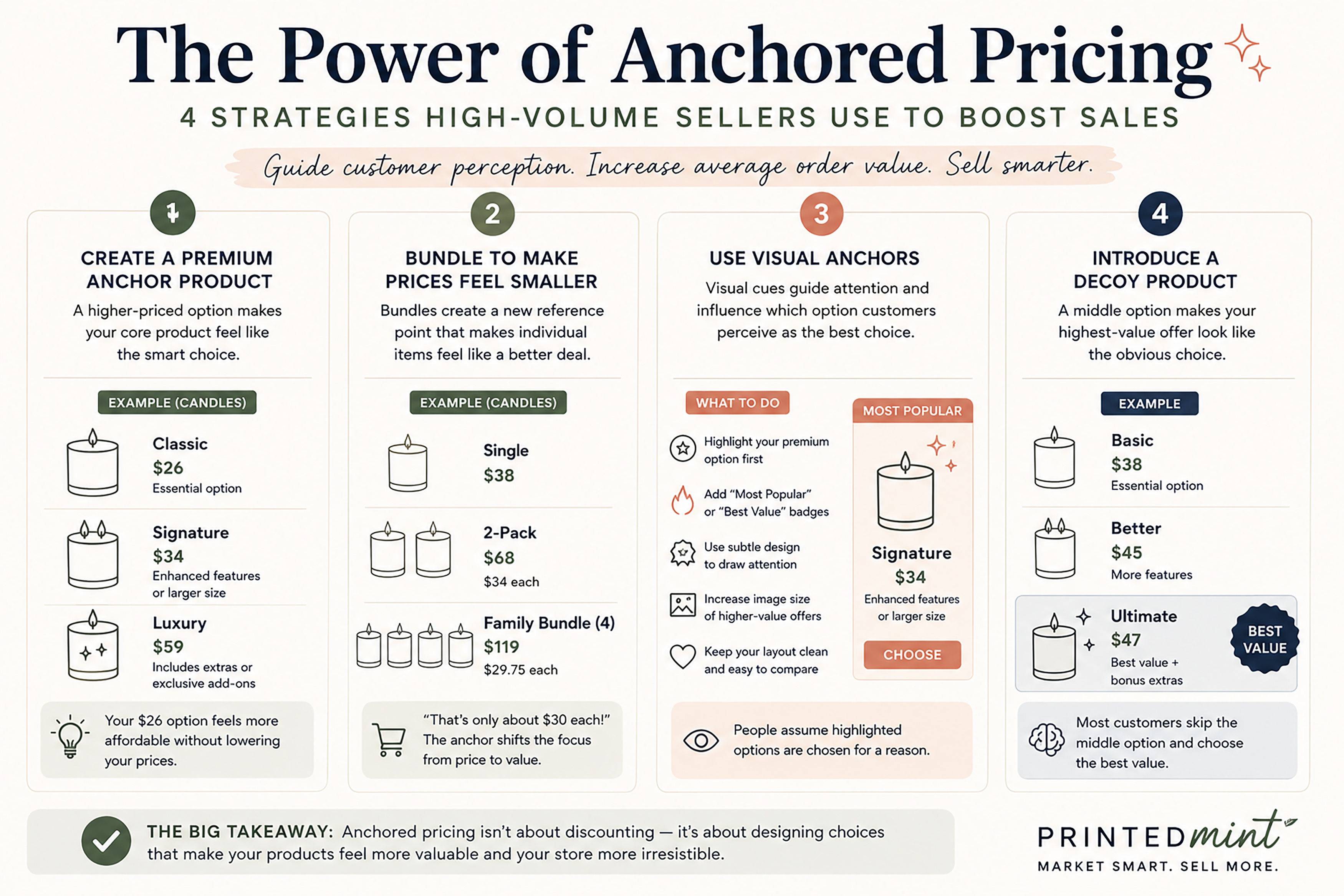
Strategy #2: Bundle to Make Individual Products Feel Smaller
High-volume sellers understand that bundles create powerful anchors.
Example:
Single item: $24.95
2-Pack: $36
Customers begin calculating:
"Wait...that's only about $18 each."
Now the original price no longer feels expensive.
The anchor shifts attention away from cost and toward value.
Strategy #3: Use Visual Anchors
Anchors aren't just numbers.
Presentation matters.
Power sellers often:
- Highlight "Most Popular"
- Add "Best Value"
- Display sale percentages
- Add subtle badges
- Position premium choices more prominently
Customers assume highlighted products are selected for a reason.
Small design choices create major differences.
Strategy #4: Introduce a Decoy Product
This strategy is incredibly common among large brands.
Example:
Small Product: $12.95
Standard Product: $18.95
Large Product: $20.95
Very few customers choose the middle option.
Instead they think:
"For just $2 more, I can get the large version?"
The middle option often exists primarily to make the upgraded version feel like the obvious choice.
Why Etsy Sellers Especially Benefit
Etsy shoppers browse by comparison.
They're constantly opening tabs and checking competitors.
Anchored pricing allows you to control the comparison before they leave.
Instead of competing solely on:
"Who has the cheapest product?"
You shift the conversation toward:
"Who offers the best value?"
That distinction protects margins.
Final Thoughts
The highest-volume Shopify and Etsy merchants rarely win because they have the lowest prices.
They win because they understand perceived value.
And often, a few small changes to your pricing structure can dramatically increase:
- Average order value
- Conversion rate
- Customer satisfaction
- Revenue per visitor
Your goal isn't to make products cheaper.
Your goal is to make your offer feel like the obvious choice.
That is exactly what top sellers do.
— The Printed Mint Team

 and then Add to Home Screen.
